Silence Has a Cost: What Holding It In Does to Your Body
Episode 36 of Informed Choice with The Naija Goddess, featuring Amy Gonzalez
Dr. Naija, Doctor of Functional Medicine, PhD
Featuring Amy Gonzalez, Bravery Activator & Soul Polisher
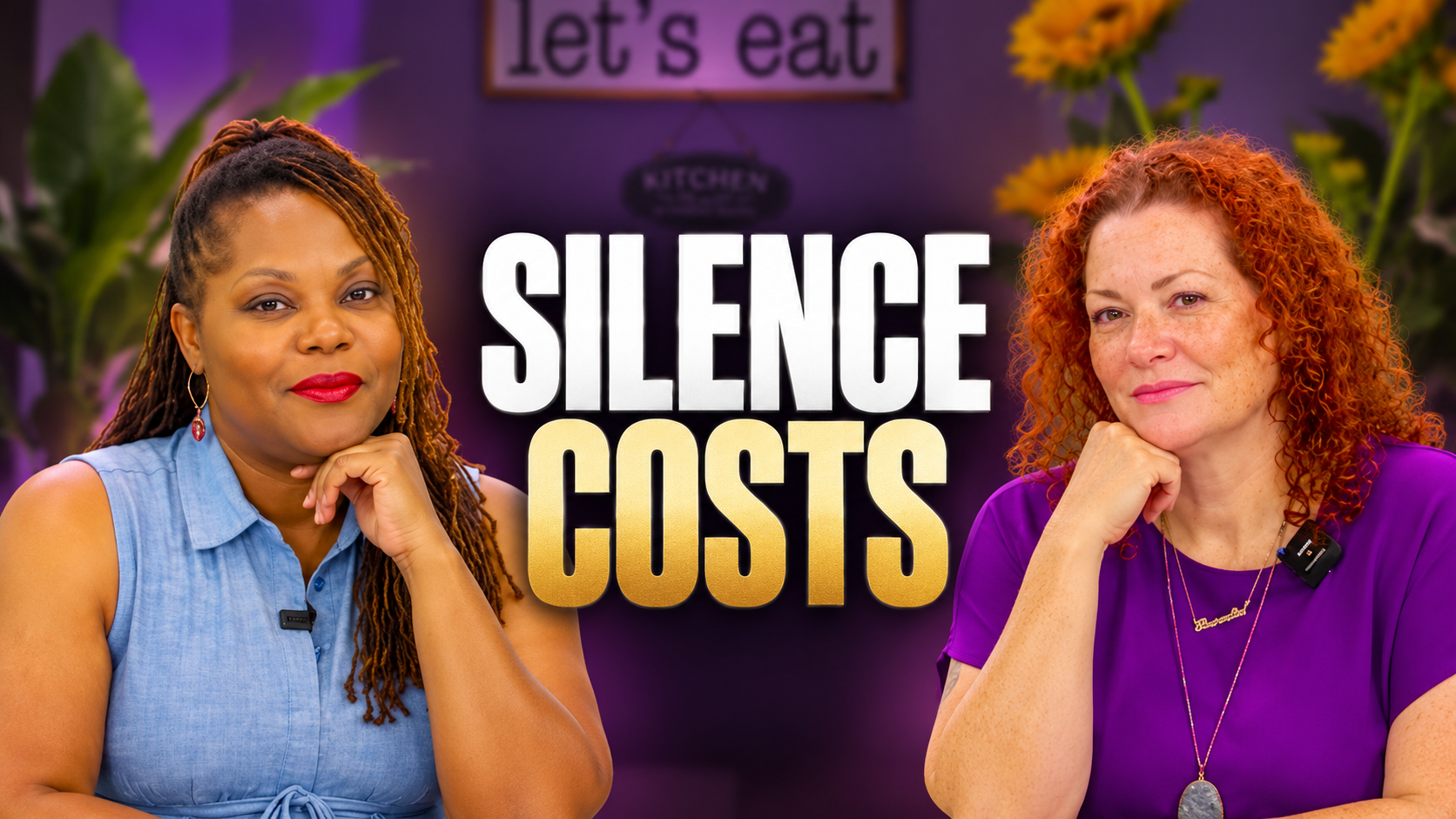
Emotional suppression rarely looks dramatic. It looks like a woman in a meeting holding back the one sentence that could change everything, because somewhere along the way she learned that speaking up would cost her more than staying quiet ever could. I am a Doctor of Functional Medicine, a chef who has owned two restaurants, and a board-certified nutritionist, so most of my conversations are about what is on your plate. In Episode 36, I sat down with Amy Gonzalez, who calls herself a bravery activator and a soul polisher, to talk about what happens when we swallow what we need to say. We looked at what that silence costs the body, not just the mind, and what changes when we stop.
Watch the Full Conversation
Episode 36 with Amy Gonzalez is streaming on the Informed Choice playlist.
Being human is the bravest act
Amy does not define bravery the way most of us do. She is clear that firefighters and soldiers are brave, and she also says that every day you choose to get up and take part in your own life is brave. Flat out. Her framework, Brave On, turns the word into an acronym: bold, resilient, authentic, vulnerable energy. It is a daily reminder, her own version of a mantra, and she offers it to the women she works with so they can see it in themselves.
The four P’s, built in the middle of the storm
Most people build a framework after they get through something hard. Amy built hers while she was still in it. The four P’s are perspective, practice, patience, and purpose. Perspective means looking beyond your own tunnel vision. Practice means actively participating in your life. Patience means giving yourself permission to pause instead of rushing to step ten. Purpose, for Amy, means purpose for today, not the grand version. She also told me they are not a ladder. They are cyclical, and they happen at the same time.
What your body is doing while you stay quiet
Here is the clinical side of our conversation. When I think about chronic self-silencing, I picture a stress response that never fully switches off. Research is starting to support the connection. In a study of adults in their early forties, higher use of emotional suppression was associated with higher C-reactive protein, a marker of inflammation. A study of trauma-exposed veterans found the same pattern. These are observational studies, so they show an association, not proof of cause, and a 2025 study suggests culture shapes how much suppression matters. Still, it fits what I see in clinic: women who have checked every physical box and are surprised that their emotional state shows up in their body. I did this for years myself, and I also spent years ignoring my intuition because of social norms. Every time it was right.
Stress also has a nutrient side. The adrenal glands are among the most vitamin C-rich tissues in the body, and a human study found they release vitamin C when the stress response is triggered. That is why I chose rose hips for this episode’s herbal spotlight.
Finding your voice without over-explaining
Amy described an inner pilot light that you can turn up or down. When we are not centered, we tend to over-explain. Returning to center helps you communicate with discernment: say what you need, in the time you need to say it. Her first step for a woman who feels something is off is to notice the physical signal. Your body usually knows before your mind admits it.
Movement, because talking is not always enough
Amy found Nia, a fusion movement practice, during a hard season, and she cried through her first class because she had given herself permission to move. That led to her Brave On dance breaks. I will not oversell the mechanism, but I will say this: if sitting still or talking has not released it, try moving.
Herbal spotlight: rose hips
Rose hips are one of the most concentrated whole food sources of vitamin C. I like them as a tea. Use one to two teaspoons, steep them overnight in cold water or warm for about ten minutes, and have one to two cups a day. Vitamin C is heat sensitive, so gentle steeping preserves more of it. You can also find rose hips as a powder for smoothies. If you take blood thinners, check with your healthcare team before adding them.
The dish: Moroccan inspired couscous
For the food segment, I made a Moroccan inspired couscous because Amy mentioned she loves Mediterranean and Latin flavors. It has chickpeas for protein, roasted zucchini, peppers, and carrot for fiber, almonds for healthy fat, and mint, parsley, cilantro, lemon, and warm spices for flavor. That is the PF³ Framework on one plate: protein, fiber, fat, and flavor. It keeps four to five days in the fridge and freezes well for up to two months. My written recipe uses fonio, and couscous or millet work too: get the recipe here.
The informed choice
I ask every guest for one informed choice to consider this week. Amy’s was simple: acknowledge that being human is brave. If you want a place to start, stand at a mirror, close your eyes, and ask where you feel it today. Notice the first answer, whether it is your lower back, your throat, or your head, and then ask what is really going on in your life. You might be doing better than you think.
You can find Amy at helloamygonzalez.com and on Instagram and YouTube at @helloamygonzalez. Watch her Brave On dance breaks, try one yourself, and tag her.
Research referenced:
- Appleton et al., 2013, Health Psychology: Emotional suppression and C-reactive protein.
- Khan et al., 2020, Psychoneuroendocrinology: Suppression and inflammatory markers in trauma-exposed populations.
- Watanabe et al., 2025, International Journal of Clinical and Health Psychology: Cultural moderators of emotional regulation.
- Padayatty et al., 2007, American Journal of Clinical Nutrition: Human adrenal gland vitamin C dynamics during the stress response.