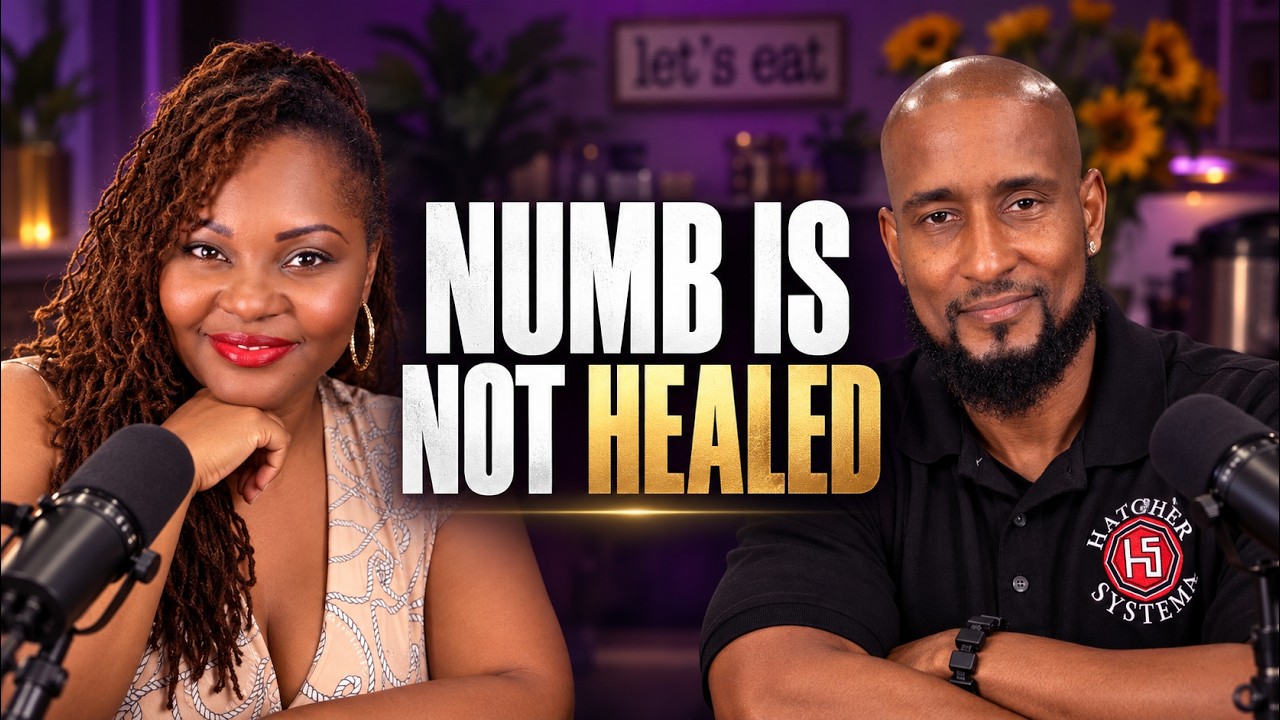
Chronic stress can leave the body braced long after danger has passed. Dr. Naija and Roy Hatcher explore how Systema uses breathing, posture, movement, and calmness to help restore regulation from the body outward.
Your body has been sending you signals for years. The tension that will not release. The sleep that never fully restores. The reactions that feel too big for what triggered them. These are not character flaws. They are data. And most people have been taught to ignore them.
As a Doctor of Functional Medicine and board-certified holistic nutritionist, this is the conversation I keep coming back to: the body does not break down randomly. It gives warnings first. What Roy Hatcher taught me on this episode of Informed Choice is that most of those warnings trace back to one thing, a nervous system that never got the signal that the threat is over.
What Is Systema? The Russian Martial Art That Goes Far Beyond Fighting
Systema is a Russian martial art that has been practiced for over ten centuries. Unlike conventional martial arts, Systema is not organized around techniques, belts, or competitive performance. Its foundation is a single principle: know thyself.
Roy Hatcher, certified directly by Systema master Vladimir Vasiliev in 2012, describes it this way: Systema teaches you to master the most basic things you already think you know how to do. Breathe. Stand. Move. Be still under pressure. Most people discover, when they actually practice it, that they have been doing all of it on autopilot and leaving a significant amount of their own capability on the table.
Systema is not a fighting style that happens to include breathwork. It is a complete body-intelligence system in which fighting is one application among many.
The Four Pillars of Systema: What They Are and Why They Work Together
Systema is built on four pillars: breathing, posture, movement, and calmness. Understanding how these interact is what separates Systema from any trendy breathwork protocol.
Breathing is the master regulator. It is the only autonomic function the body allows you to consciously control, which means it is the direct access point to your nervous system.
Posture is not aesthetic. It is structural. When the body is chronically misaligned, it cannot breathe diaphragmatically. Shallow chest breathing follows, which keeps the nervous system in a low-grade state of alert.
Movement becomes efficient when the first two pillars are in place. When the body is relaxed, aligned, and breathing fully, movement requires less effort and produces more result.
Calmness is where most people misunderstand Systema. Calmness is not the outcome you arrive at after managing stress. It is the baseline state you maintain before stress arrives, so that when it does, you process it through a filter instead of being overtaken by it.
Skill Without Control Is a Loaded Weapon
One of the most clinically significant points Roy makes is the distinction between skill and control. Skill refers to learned capability. Control refers to the ability to direct that capability through emotional regulation. Without control, skill becomes unpredictable and potentially dangerous.
Roy puts it plainly: a highly skilled person without emotional regulation is exactly like a loaded weapon in unsteady hands. The force is real. The direction is not.
This applies far beyond self-defense. It applies to how people handle conflict, how they respond to their children, how they navigate a hard phone call, how they react when someone cuts them off at a red light. The skill to speak, to move, to respond is already there. The question is whether the nervous system has been trained to apply it with intention or whether fear and anger are making those decisions instead.
Why Your Nervous System Gets Stuck in Fight-or-Flight
When the body perceives a threat, the hypothalamic-pituitary-adrenal axis activates and cortisol rises. In a healthy stress response, this activation is short, purposeful, and followed by a return to parasympathetic baseline. The problem for most people today is that the body never gets the all-clear signal. It stays in low-grade sympathetic dominance, sometimes for years.
Here is where the clinical picture becomes critical. Elevated cortisol directly triggers magnesium excretion through the kidneys. Magnesium is involved in over 300 enzymatic processes in the body, including the regulation of the hypothalamic-pituitary-adrenal axis itself. This creates a compounding loop: more cortisol produces less magnesium, and less magnesium means the cortisol axis fires more easily and takes longer to settle. The chronically stressed person does not just feel tired. They feel like recovery is not possible, because physiologically, without addressing what the stress response is depleting, it is not.
This is why Roy's four pillars are not optional wellness additions. Breathing and posture, practiced with consistency, are physiological interventions that can begin to interrupt this loop from the top down while nutrition addresses it from the biochemical level up.
Posture Is a Health Intervention, Not an Aesthetic Concern
Roy uses a simple analogy that lands immediately: imagine a kinked hose. When the hose is bent, water cannot pass through at full flow. The same is true of every blood vessel, nerve pathway, and spinal structure in the body. Chronic postural misalignment does not just create pain. It creates compression, restriction, and a constant low-grade activation of the sympathetic nervous system.
When muscles are chronically contracted, the body interprets that contraction as a state of readiness, as if a threat is still present. This is why people who carry tension in their shoulders, neck, and jaw often cannot fall asleep even when they are completely exhausted. The body's own posture is telling it the danger has not passed.
Relaxed posture makes diaphragmatic breathing possible. Diaphragmatic breathing activates the vagus nerve. Vagal activation shifts the autonomic nervous system toward parasympathetic. This is not philosophy. This is a measurable chain reaction. And it begins with something as simple as stacking your spine.
Breathing With Purpose vs. Breathing on Autopilot
Most people assume that because they are alive, they know how to breathe. Systema's first lesson is that survival breathing and purposeful breathing are not the same thing.
Roy describes purposeful breathing as breathing that is conscious, directed, and calibrated to the situation. Inhaling through the nose cools the pituitary gland, helping regulate the body's internal thermal environment. Exhaling through the mouth removes that warmth, allowing the cooling effect to accumulate. Shallow chest breathing bypasses this mechanism entirely.
A foundational starting practice is this: set a timer for one minute and place your full attention on your breath without applying any technique. The inability to do this for one minute without mental distraction is itself a clinical finding. It means the nervous system is running the show rather than the person. Awareness must come before technique. Without the ability to feel what the body is doing, any technique applied to it is just performance.
The Mirror Test: A Nervous System Diagnostic You Can Do Right Now
Roy offers a practice that sounds simple and reveals everything. Stand in front of a full-length mirror, look yourself directly in the eyes, and say out loud: I love you. I am enough. You are amazing.
If a shiver moves through you, if you feel resistant, awkward, or an unexpected surge of emotion, that is not a character flaw. That is interoceptive data. Interoception is the ability to accurately sense and interpret signals from inside the body. Research consistently shows that people with high interoceptive awareness have lower cortisol reactivity, better emotional regulation, and faster recovery from stressful events.
That shiver is the nervous system reporting the gap between how a person is living and what the body actually knows to be true. The mirror test does not create the problem. It reveals one that has been running quietly in the background for a long time.
The Proof of Concept: A Wife, a Funeral Home, and Twenty Years of Training
Roy shared something during this episode that I have not been able to stop thinking about.
His wife, a master barber with nearly 30 years of experience, was asked by the family to cut her late father's hair at the funeral home before his service. She had always declined such requests from others. This was her father.
Roy watched her from across the room. He could see her shoulders moving with her breath. She stayed present. She made it through. And when they got back in the truck, she told him it was the hardest thing she had ever done in her life, and she was grateful for the breathing he had taught her.
That is not a wellness testimonial. That is clinical evidence of what a regulated nervous system can carry a person through. The situation did not change. The training did.
Frequently Asked Questions
What is Systema?
Systema is a Russian martial art built on four pillars: breathing, posture, movement, and calmness. Its core principle is knowing oneself, meaning developing full awareness and command of the body under any condition, including stress, fear, pain, and physical threat.
How does breathwork reduce chronic stress?
Purposeful breathing activates the vagus nerve, which signals the parasympathetic nervous system to shift the body out of fight-or-flight. Diaphragmatic breathing also helps break the cortisol-magnesium depletion loop that keeps chronically stressed people stuck in a state of poor recovery.
What are the four pillars of Systema?
The four pillars are breathing, posture, movement, and calmness. They are interdependent: relaxed posture enables deep breathing, deep breathing activates calming nerve pathways, and both together make movement more efficient and calmness a baseline rather than a destination.
How do I start a breathwork practice?
Roy's recommendation for beginners is to set a timer for one minute and simply observe the breath without applying any technique. The goal is awareness first. Once you can feel the breath and where it lives in the body, structured techniques such as triangle breathing, rectangle breathing, or the double-exhale method become far more effective.
What is the cortisol-magnesium loop?
When cortisol rises in response to stress, the kidneys excrete magnesium. Since magnesium regulates the hypothalamic-pituitary-adrenal axis, the hormonal system that produces cortisol, its depletion makes it harder for the body to return to baseline. This loop is one reason chronically stressed people feel like they cannot recover no matter what they do.
Listen to the Full Episode
Everything covered here is a fraction of what Roy and I got into on this episode of Informed Choice. We also cook live in the studio: gochujang glazed super firm tofu with sesame bok choy over wild rice, a dish built specifically to replenish the nutrients chronic stress depletes. And we cover black seed, Nigella sativa, and its direct effect on the GABA-A receptor pathway.
Watch or listen to the full episode now. And if you are not already subscribed to the Informed Choice newsletter, this is where the deeper teaching continues every week: head to TheNaijaGoddess.com and click Subscribe at the top of the homepage.
Heal naturally. Live vibrantly.
Dr. Naija, The Naija Goddess, DFM, PhD
Sources and Further Reading

About the Author
Dr. Naija, The Naija Goddess, DFM, PhD
Dr. Naija is a Doctor of Functional Medicine, Board-Certified Holistic Nutritionist, Certified Herbalist, and chef with more than 20 years of culinary expertise. She is the founder of The Naija Goddess Center for Culinary Medicine, where she connects functional health insight with practical food and lifestyle strategy.